EMS Training in North Scottsdale: Why 20 Minutes Is Enough
You saw something about a 20-minute workout that’s supposed to replace hours at the gym. You rolled your eyes a little — and then looked it up anyway. That’s exactly the right instinct.
EMS training is real, the science is solid, and it’s what powers every session at BODY20 North Scottsdale. Here’s the plain-English version of what’s actually happening, why it works, and what to expect before you try it yourself.
Why 20 Minutes Is Actually Enough
The claim sounds too good to be true: one 20-minute session delivers the muscular activation you’d get from a much longer traditional workout. But the efficiency isn’t magic. It’s physics.
Your body has far more muscle fibers than a standard gym session will ever reach. Conventional training (weights, machines, bodyweight movements) typically activates 30 to 70 percent of those fibers, depending on how hard you push. The rest stay dormant. It’s not a willpower problem. It’s just how your nervous system works.
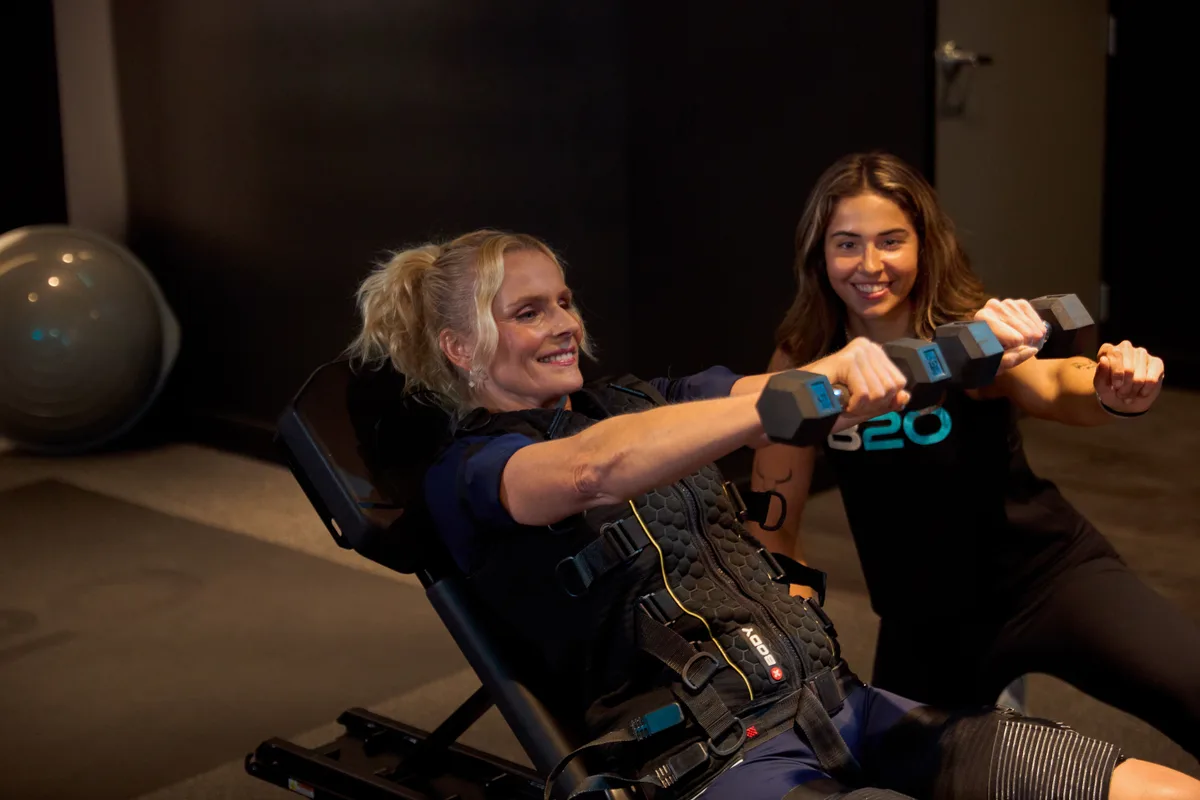
EMS reaches the fibers your gym can’t. In a BODY20 session, you wear a specialized suit embedded with electrodes. Those electrodes deliver gentle electrical impulses directly to your muscles, recruiting up to 90 percent of your muscle fibers simultaneously. Your body is doing more work in less time because more of your body is actually working.
Twenty minutes. It’s not a shortcut. It’s a more efficient path.
How EMS Actually Works
Your brain is normally in charge of making your muscles move. It sends an electrical signal down your nervous system, that signal reaches your motor nerves, and your muscles contract. EMS mimics that signal from the outside.
The suit’s electrodes deliver controlled impulses through your skin, stimulating your motor nerves directly. Your muscles respond the same way they would to a brain signal: they contract. The difference is that EMS can reach deeper muscle groups and recruit more fibers than your brain typically activates during voluntary movement.
Your brain follows traffic patterns, taking the well-traveled neural routes to the muscles it uses most. EMS bypasses the traffic and activates the whole city, including deep stabilizing muscles that standard squats and lunges rarely touch.
At BODY20, a certified coach guides you through movements while the suit does its work. You’re not passive. Your effort matters. The technology amplifies what you bring to the session.
What EMS Feels Like
This is the question most people are actually asking. The honest answer: it feels unusual, not painful.
The electrical impulses create a sensation of deep muscle engagement, similar to the feeling of a hard contraction without the strain. Most people describe their first session as surprising more than uncomfortable. By session two or three, the sensation is familiar and the focus shifts to the workout itself.
Because resistance comes from electrical impulses rather than heavy weights, there’s minimal stress on your joints. No barbell loading your spine. No impact on your knees. Just muscle activation, guided by a coach, calibrated to your level.
Your First EMS Training Session in North Scottsdale
Every BODY20 session is private — one-on-one with your coach, not dropped into a group class. You’ll change into the EMS suit, and your coach will guide you through a sequence of functional movements: squats, rows, lunges, and similar patterns. The suit amplifies the work your muscles are doing the entire time.
The session is 20 minutes. You’ll feel it. You may feel it more the next day. That soreness is real. It means muscle groups you didn’t know you were neglecting have finally been put to work.
Who It’s Built For
EMS training fits a wide range of people. Two groups tend to stick with it most.
The first is someone who simply doesn’t have time. If your schedule is full and the gap between intention and actual workouts keeps growing, 20 minutes solves the math problem. One session per week fits into a schedule that a standard gym routine doesn’t.
The second is someone coming back to fitness after a gap. Maybe it’s been a while. Maybe you’re working around an old injury, some recent life changes, or joints that don’t love high-impact movement. EMS offers a way back in. The low-impact design and one-on-one coaching mean you start where you are, not where a class assumes you should be.
EMS training isn’t a wellness trend. It’s a technology with roots in physical therapy and athletic performance, adapted for boutique fitness in a low-impact, one-on-one format.
If you’ve been curious but skeptical, that’s a reasonable place to start. The first session is the best way to understand it.
Ready to try it? Book your first session at BODY20 North Scottsdale →